Before
Standard Approach
- Accept the tests your oncologist orders.
- Try one treatment at a time, sequentially.
- Wait for your doctor to suggest next steps.
- Accept “no further options” at face value.
- Hope someone else is tracking your data.
Patient empowerment for AI assistants
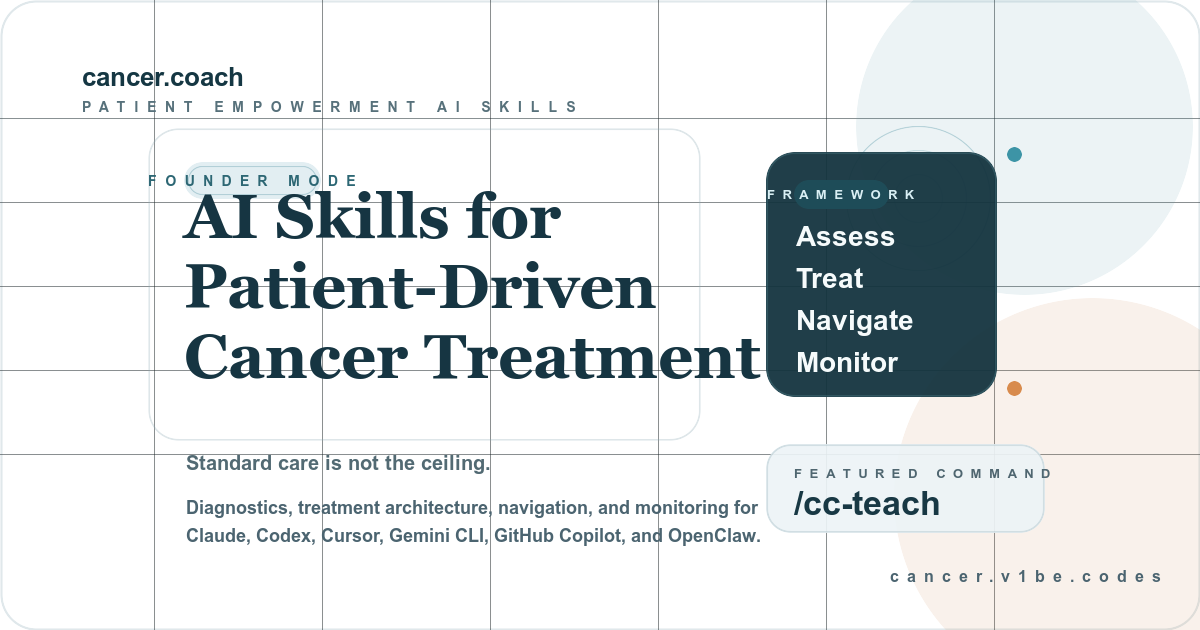
Standard care is not the ceiling.
A skill pack for navigating cancer with agency — maximum diagnostics, parallel treatments, regulatory navigation, and systematic monitoring. Built on the framework that took one patient from terminal prognosis to undetectable disease.
The shift
Before
After
Informed. Empowered. Systematic.
The framework
Master orchestrator
Start here for new diagnoses, cross-phase decisions, and founder-mode coaching. It routes you to the right skill at the right time in your journey.
Molecular profiling, genomic sequencing, staging, diagnostic strategy.
Treatment architecture, parallel therapies, personalized medicine, evidence evaluation.
Clinical trials, expanded access, team assembly, insurance, tissue rights.
MRD testing, imaging cadence, biomarker tracking, response assessment.
The skill set
The senior navigator in the system. It understands where you are in your cancer journey, which decisions are coupled across phases, and when to escalate or pivot.
Example prompt
Use the cc-strategist skill. I was recently diagnosed with
stage III osteosarcoma. Help me understand my options and
build a plan for taking an active role in my treatment.Example prompt
Use the cc-assess skill. My oncologist ordered a CT scan
but I want to understand what genomic profiling options
I should be requesting for recurrent osteosarcoma.Example prompt
Use the cc-treat skill. My cancer recurred after standard
chemotherapy. Help me evaluate whether parallel treatment
approaches might be appropriate for my situation.Example prompt
Use the cc-navigate skill. I need to find clinical trials
for recurrent osteosarcoma and understand how to apply for
expanded access to experimental immunotherapies.Example prompt
Use the cc-monitor skill. Help me set up a monitoring
protocol to systematically track MRD, imaging, and
biomarkers between my treatment cycles.The principles
Every piece of information about your cancer is potentially actionable. Don't settle for the minimum workup when molecular profiling, genomic sequencing, and liquid biopsies might reveal targets that standard tests miss.
When standard care has failed and time is limited, testing multiple therapeutic hypotheses simultaneously — with non-overlapping toxicity — can compress months of trial-and-error into weeks of informed iteration.
You are not a passive recipient of medical care. You are the architect of your treatment strategy. Your medical team provides expertise; you provide direction, coordination, and the determination to explore every option.
Your medical data belongs to you. Organizing it, understanding it, and sharing it with your full team — and potentially with the research community — creates better decisions and advances science for future patients.
Get started
Install the full patient empowerment framework, then start with
cc-strategist or run /cc-teach to
capture your diagnosis context first.
Install
npx skills add cancer-coach/skills
Manual installation is also available if you prefer to extract the skill folders directly into your project.
Frequently asked
Cancer patients, caregivers, and patient advocates who want to take an active, informed role in treatment decisions using the AI tools they already have access to.
No. These skills provide frameworks for patient empowerment and education — helping you understand your options and ask better questions. All medical decisions should be made with your qualified healthcare team.
Coined by Sid Sijbrandij (GitLab co-founder), it means treating your cancer like an engineering problem: gathering maximum information, assembling the right team, testing hypotheses in parallel, and iterating based on data. It's about taking agency, not replacing your doctors.
Start with cc-strategist. If you want more tailored
guidance, run /cc-teach first to capture your
diagnosis, staging, treatments, and goals before working through
any phase skill.
No. The skills are designed to make complex oncology concepts accessible. They translate medical jargon into clear frameworks and give you specific questions to ask your medical team.